


Website Migration SEO Services
A new site shouldn't cost you the rankings the old one earned. We protect your organic traffic before launch, on launch day and through the weeks after.
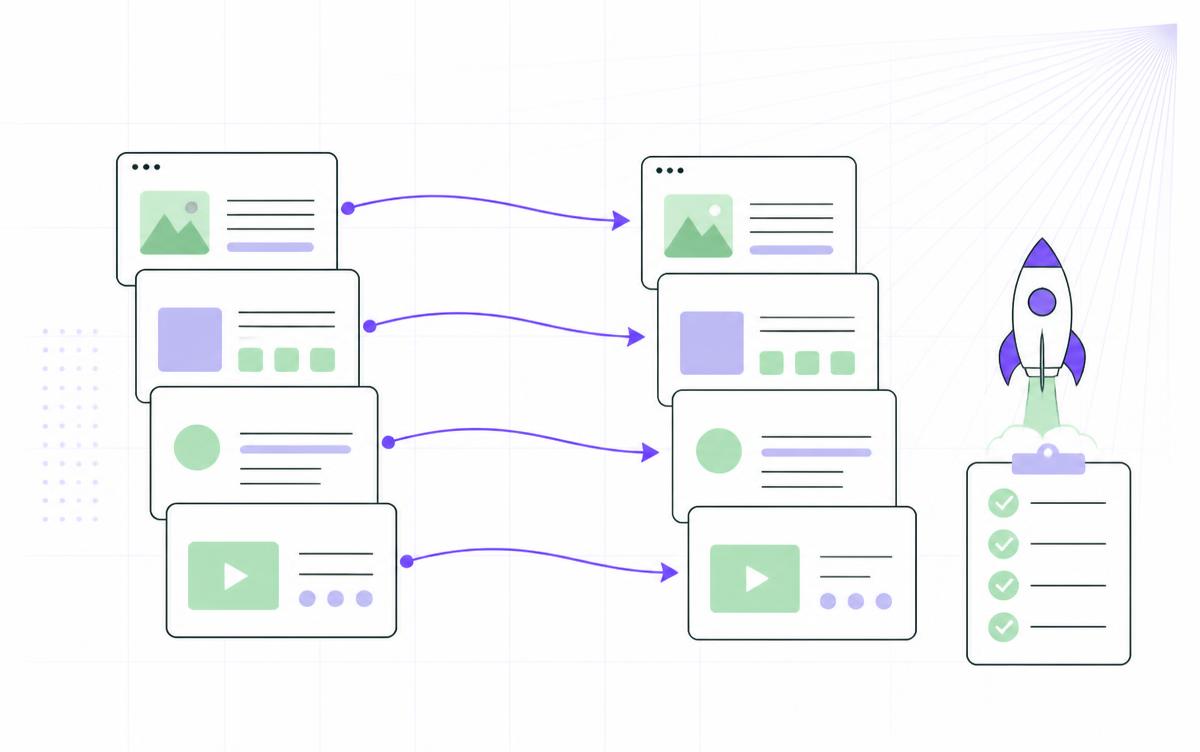
Website migration SEO is the difference between a new site that keeps the rankings your old one earned and a launch-day traffic graph shaped like a ski slope. Here's what nobody selling panic will admit: migrations don't kill rankings. Skipped steps do.
Nearly every post-migration traffic drop traces back to something preventable — a redirect map nobody finished, a staging robots.txt that went live with the site, content quietly binned during the redesign. Shopify move, headless rebuild, domain merge, new theme — the label changes, the fix doesn't: a methodical process, followed to the letter. It's boring work. Boring is what keeps your rankings.
The most dangerous phrase in any rebuild is "the redirects are handled".
Why do websites lose traffic after a migration?
Search engines have spent years attaching trust to your exact URLs. Every ranking, every backlink, every signal points at a specific address. Change those addresses without telling anyone and, as far as Google is concerned, your site didn't move — it vanished, and a stranger turned up in its place.
The failures are rarely exotic. The same handful of skipped steps cause almost all of the damage we see:
- Redirect maps that 302 everything to the homepage — temporary redirects that pass nothing, pointed at a page that answers nothing
- The staging robots.txt going live with the site, politely asking Google not to index your brand-new build
- Content deleted or thinned in the redesign because "nobody reads that page" — Google did
- Internal links, canonical tags and sitemaps still pointing at URLs that no longer exist
- Page speed and rendering getting worse on the new platform, unnoticed because the design looks lovely
None of these needs a genius to prevent. They need someone whose actual job is to check — before, during and after go-live.
Does a redesign count as a migration?
Yes, and this is the one that catches people out. "We're not migrating, we're just redesigning" is how most of the damage we see gets done. "Redesign SEO" and "migration SEO" aren't two different services — a redesign changes your templates, your heading structure, your internal linking and usually your content, and every one of those is a ranking input.
Your dev agency will tell you it's just a reskin. Then the new theme ships with subtly different URL slugs, half the copy "streamlined" away, and H1s swapped for whatever looked nicest in Figma. Same risks as a full replatform, prettier excuse. We treat every redesign as a migration, because functionally that's exactly what it is — and the checks cost far less than the recovery.
The six checks that keep your rankings
They happen in this order, every time, because the order is the point:
- 01Benchmark crawl and audit — a full snapshot of the live site while it still exists: every URL, every ranking page, every piece of content earning traffic. Our SEO audit services feed this stage, and it must happen before the old site goes offline.
- 02Redirect mapping — one-to-one 301s from every old URL to its closest new equivalent. Not a blanket rule that dumps everything on the homepage and hopes.
- 03Content and template review — checking what the new build keeps, changes or deletes, while it's still a decision rather than a recovery job.
- 04Staging checks — crawling the staging site to catch broken canonicals, stray noindex tags, missing metadata and half-finished redirects while they're cheap to fix.
- 05Launch-day QA — redirects tested the moment the site goes live, robots.txt verified, sitemaps resubmitted, indexing watched from hour one. Yes, even when the agency insists on going live at 4:45 on a Friday.
- 06Post-launch monitoring — crawls, rankings and traffic compared against the benchmark, so any wobble is spotted and traced within days, not quarters.
When should you bring SEO into a migration?
Before the build, ideally. The cheapest migration problems are the ones caught in a spreadsheet three weeks before launch, not in Search Console three weeks after. If your rebuild is still in progress, we slot in alongside your dev team, hand them a redirect map and a checklist, and mark their homework at staging. Most developers are quietly relieved — nobody wants to be the reason traffic halved.
Already launched and watching traffic slide? That's the other half of website migration SEO — and a regular part of our casework. Post-launch, the job is diagnosis: comparing what the site looks like now against what ranked before, finding the skipped steps and fixing them in priority order. We won't quote you a recovery percentage — a percentage implies we've seen your Search Console, and we haven't yet — but traffic lost to technical causes has technical fixes, and the sooner they're applied, the less ground there is to claw back.
What happens after launch day?
Launch is the halfway point, not the finish line. Search engines take weeks to fully re-crawl a changed site, which makes the first month after go-live exactly when problems surface — and when they're cheapest to correct. So the benchmark comparison keeps running: rankings against pre-launch positions, fresh crawls against the old architecture, Search Console against the baseline we captured before anything changed.
And it's not just Google re-reading your site after launch. AI assistants recommend businesses now too, and they crawl the new build just like Google does. A replatform can change what they find — structure, content, whether their bots can get in at all. Our AI visibility tracking watches for exactly that, and because we're an AI SEO agency before we're anything else, we treat "findable in ChatGPT" as part of the same job as "findable in Google". One migration, both audiences protected.
How much does website migration SEO cost?
The price tracks the redirect map, not the design. Forty URLs moving to a new theme is an afternoon of mapping; forty thousand changing platform and domain in the same weekend is a project. We scope each migration individually and quote a fixed fee before the work starts — no surprises, no meter running.
The honest comparison isn't migration support versus nothing; it's prevention versus recovery. Prevention is a scoped project with an end date. Recovery is an open-ended diagnosis while your traffic sits below where it used to be. If you want to see how migration work fits alongside everything else we do, our full SEO services are one page over.
Got a go-live date on the calendar — or a traffic graph you'd rather not show the board? Either way, the next step is a conversation, not a contract.
Talk to us before go-liveQuestions we get asked
How long does website migration SEO take?
The SEO workstream runs alongside your build rather than delaying it — benchmarking and redirect mapping happen during development, QA happens on launch day, and monitoring continues for several weeks after. The one hard deadline is the benchmark crawl, which must be captured while your old site is still live. Miss that window and you lose the record of what ranked and why.
Will my rankings drop after a website migration?
Some short-term movement is normal — search engines need a few weeks to re-crawl and re-evaluate a changed site, so expect a wobble even in a clean migration. What isn't normal is a sustained drop that never recovers. That almost always points to a specific missed step — broken redirects, blocked crawling, deleted content — and specific missed steps are findable and fixable.
Can you recover traffic lost after a migration that has already happened?
Usually, yes. Most post-migration losses have technical causes, and technical causes have fixes. We diagnose by comparing the current site against a reconstruction of what ranked before, then work through the issues in order of impact. What we won't do is put a recovery number on it up front — the honest answer depends on what we find. The sooner that work starts, the less ground there is to make back.
Do I need migration SEO if my URLs aren't changing?
Almost certainly. URLs are one ranking input among many — a redesign that keeps every URL can still change templates, heading structure, internal linking, page speed and the content itself, any of which can move rankings. The checklist is lighter when URLs stay put, but skipping it entirely is how "it's just a reskin" turns into a traffic problem.
When should I involve an SEO team in my website migration?
As early as the decision to rebuild — it's far cheaper to influence a site structure than to retrofit one. Failing that, any point before launch still allows the essentials: benchmark crawl, redirect map, staging checks. If you've already launched and traffic is down, involve someone now. Every week of delay adds to the recovery time, because search engines are re-evaluating the broken version.
See what search and AI are saying about you
A 30-minute call, a straight answer, and the three things we would fix first.