


AI Visibility Tracking: See What AI Tells Your Buyers
AI assistants are already answering your buyers' questions. We track whether you're in those answers, who's there instead, and how to change it.
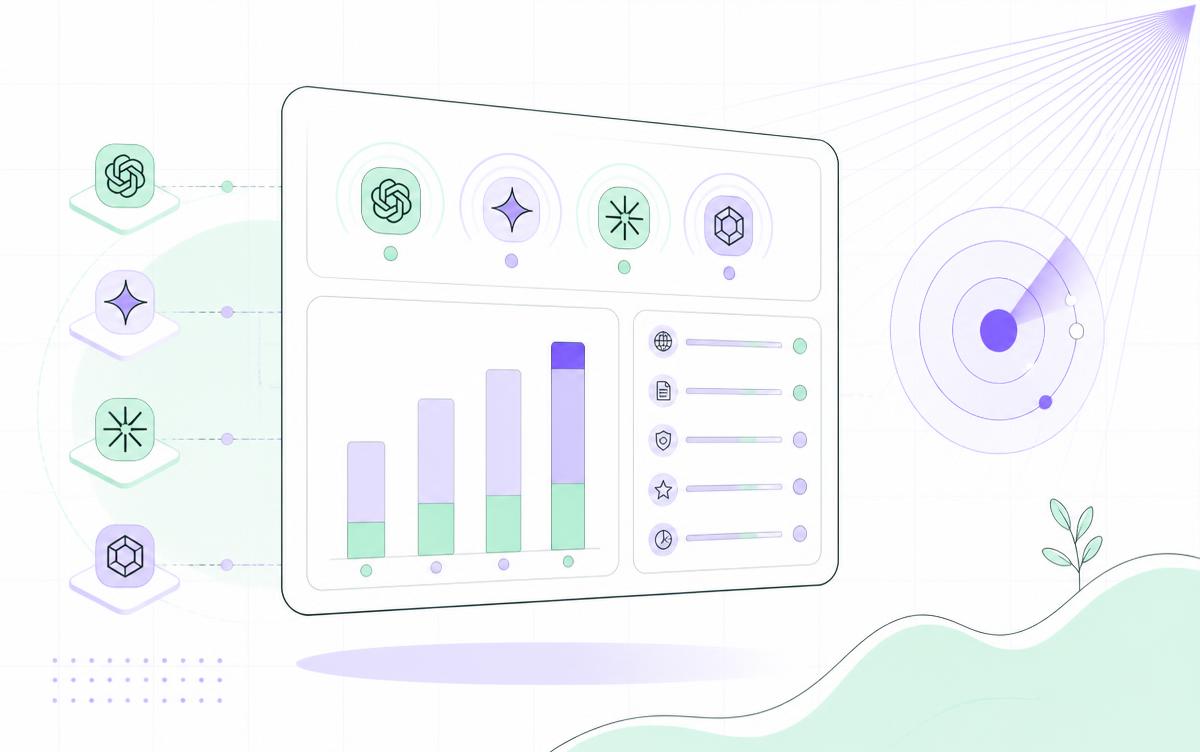
AI visibility tracking does one job: it counts how often ChatGPT, Perplexity, Google AI Overviews and Microsoft Copilot name your business when buyers ask the questions that lead to deals. Where a rank tracker watches a results page, it watches the answer itself.
It matters because your buyers have quietly changed how they search. They ask AI for shortlists, comparisons and recommendations, and they get confident, specific answers back. If those answers never include you, you're losing deals that never show up in your analytics. We track what AI says about you — and help you change it.
What is AI visibility tracking?
Think of it as rank tracking, rebuilt for a world where the answer is the destination. Traditional SEO tools tell you where you sit on a results page. AI visibility tells you something more useful: when someone asks ChatGPT to recommend a supplier like you, does your name come up - or does your competitor's?
Here's the awkward part: AI answers aren't stable. Ask the same question twice and you can get different names, different sources, different advice. A screenshot of one good answer proves nothing. Proper AI visibility tracking means running a structured set of questions across multiple platforms, repeatedly, over time. That's what turns curiosity into usable evidence: your baseline, your trend, your gaps.
You can't fix an answer you've never seen.
What's included
AI visibility tracking with us covers four things, and each one is there to answer a question you'd actually ask.
- **Platform coverage.** We track the assistants your buyers use day to day - ChatGPT, Perplexity, Google AI Overviews and Microsoft Copilot - so you can see how your visibility differs from platform to platform.
- **A question set built around your buyers.** The real questions people ask before buying from a business like yours, from early research right through to 'who should we shortlist?'
- **Competitor share of voice.** Who gets named when you don't? We measure how often each competitor appears across your question set, so you know exactly who is winning the recommendations you're missing.
- **Citation sources.** AI assistants lean on specific websites when they build answers. We identify which sources get cited in your market, because that's where your visibility is decided.
How the process works
Structured, quick to start, and designed to get you evidence before you commit to anything bigger. Five steps from first conversation to first report.
- 01**Discovery.** We work out what your buyers actually ask, in their words: the questions that lead to shortlists, comparisons and purchases in your market.
- 02**Question set build.** We turn those questions into a structured set we can run consistently, month after month, across every platform we track.
- 03**Baseline run.** We run the full set and record every mention, absence, competitor appearance and cited source. This is your AI visibility check: where you stand today, in black and white.
- 04**Monthly tracking.** We re-run the set on a fixed cadence, because AI answers shift as models and sources update. One check is a snapshot; the trend is the story.
- 05**Recommendations.** Every month you get clear, prioritised actions: what to publish, fix or build to show up more often in the answers that matter.
What you get
You get three things from us — no portal, no padding, nothing you'd dare call a 'deliverable'. All in plain English, none needing a data-science degree to read.
- **A baseline report.** Where you appear, where you don't, who shows up instead of you, and which sources the AI platforms lean on in your market.
- **Monthly tracking reports.** Your visibility trend over time — movements, new competitor mentions, changes in cited sources, and what's most likely driving them.
- **Prioritised recommendations.** The specific content, technical and authority moves most likely to improve your AI visibility, ranked by effort and likely impact.
Everything is built to be forwarded — to your board, your wider team, or the sceptical co-founder who still thinks AI search is a fad. And because the question set stays consistent month to month, each report compares cleanly with the last: you can see whether things are moving without squinting.
Who is this for?
B2B marketing leads and founders, mostly — people who've asked ChatGPT about their own market, winced, and now want proper evidence before committing budget. It suits early movers who want to get ahead while this space is still quiet, and careful spenders who want proof before parting with a pound. If you'd rather see data than take an agency's word for it, good; that's the right instinct, and it's exactly who this service is built for. Start with a baseline, then scale up only when the evidence says you should.
It's not just software and services, either. The same shift is hitting plumbers and dentists — buyers ask 'best emergency plumber near me' or 'which dentist does invisible braces' and let the AI pick. The recommendation happens inside the answer, before anyone clicks anything. Browse the industries we cover to see where you fit.
Tracking is step one. Fixing is step two.
Measurement on its own changes nothing. Plenty of AI visibility tracker tools will happily sell you a dashboard and leave you staring at it. The point of tracking is knowing precisely where to act, and acting is where we earn our keep. It also stops you fixing the wrong thing first, which is the most expensive mistake in this whole area.
Improving AI search visibility comes down to three levers. Content: publishing genuinely useful answers to the questions your buyers ask. Technical: making your site easy for AI systems to crawl, read and quote. Authority: earning mentions and links on the sources AI already trusts and cites. Your tracking data shows which lever to pull first, in which order, for which questions, so nothing is guesswork. Explore our full set of services to see how the fixing side works.
Your buyers are already asking AI. Find out what it's telling them.
Check my AI visibilityQuestions we get asked
How do I check my AI visibility?
Ask ChatGPT, Perplexity and Copilot the questions your buyers ask, and note whether you're mentioned — that's a rough manual check anyone can do today. The catch is that AI answers vary between runs, platforms and phrasings, so one session tells you very little. A proper AI visibility check runs a structured question set repeatedly across platforms and records the results, which is what turns anecdotes into evidence.
Which AI platforms do you track?
We track the four AI assistants UK buyers use most: ChatGPT, Perplexity, Google AI Overviews and Microsoft Copilot. Coverage is weighted towards where your buyers are, not spread thinly for the sake of a longer list. If your market leans heavily on one platform, your question set and reporting lean the same way.
Is AI visibility the same as SEO rankings?
No — rankings measure your position in a list of links, while AI visibility measures whether you're named in the answer itself. They're related, because AI systems draw heavily on sources that already perform well in search, but they're not interchangeable. You can rank on page one for a term and still never be named when ChatGPT answers the same question.
How often do AI answers change?
Often enough that a single check goes stale quickly. Models update, source websites change, and the same question can produce different answers from week to week. That's why AI visibility tracking runs monthly: frequent enough to catch real movement and connect it to what you've published or fixed, without drowning you in noise.
Can I improve my AI visibility once I know where I stand?
Yes, and the first lever is usually content: publishing strong, direct answers to the questions you're currently absent from, because that's the fastest thing to change and the easiest for AI systems to pick up. Technical and authority work move slower but compound. Expect the first months of tracking to look quiet before mentions appear — models refresh on their own schedule, which is why the trend matters more than any single check.
See what search and AI are saying about you
A 30-minute call, a straight answer, and the three things we would fix first.