


The B2B demand generation agency that creates demand — then captures it
The lead-gen playbook has stalled and every agency page sounds the same. Here's the version that creates demand, captures it in Google and ChatGPT, and doesn't invent the numbers.
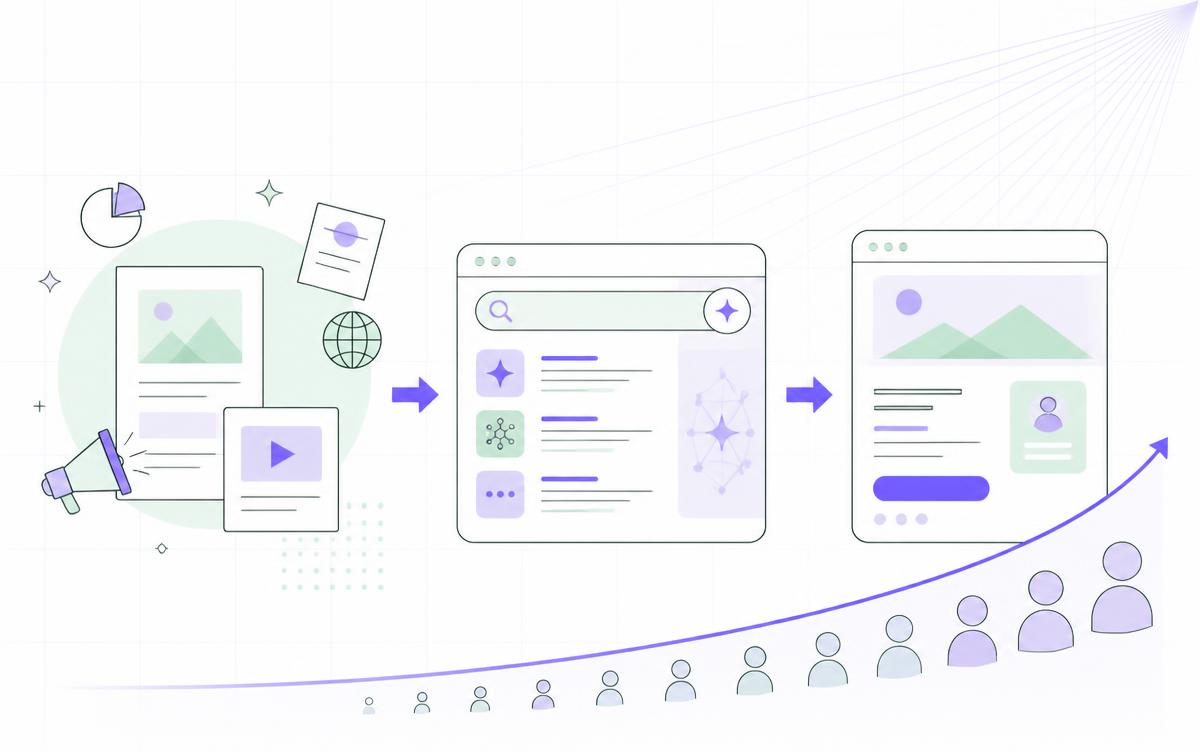
A demand generation agency makes people want what you sell before they go looking for it — then makes sure you're the answer when they do look, whether that's in Google or a ChatGPT window. Nothing else on this page is more complicated than that. Not more form fills. Not another gated PDF that sales will stop chasing by Thursday.
If you're here, the playbook has probably stalled: outbound gets ignored, CPCs climb, and the 'qualified' leads aren't. You've also read four agency pages today that all promised predictable pipeline with a straight face. We'll try to be more useful.
What does a demand generation agency actually do?
Strip out the jargon and it's three jobs, in a specific order.
- Create demand — put a point of view, original data or a genuinely useful idea in front of buyers who weren't looking for you, so that later, they do.
- Capture demand — be the obvious answer when those buyers start searching: rankings, AI citations, the shortlist, the brand they half-remember.
- Convert demand — make sure the site they land on turns interest into actual conversations, not bounces.
Most agencies sell you the middle job and call it the full stack. Capture-only works right up until you run out of people already searching — then you're bidding against every competitor for the same shrinking pool and wondering why every lead costs more than the last. A proper demand generation agency does all three jobs, in that order.
Demand generation vs lead generation: the difference everyone claims to understand
Lead generation harvests demand that already exists. It swaps a whitepaper for an email address, runs ads at in-market keywords, and fills the CRM with people who may or may not remember downloading anything. Demand generation creates the want in the first place — it changes what buyers are looking for before they enter the market.
Put another way: lead gen asks 'who can we get into the pipeline this month?' Demand gen asks 'when this buyer finally has budget, whose name is already in their head?' Neither is wrong. The trouble starts when an agency runs pure lead gen — gated ebooks, cold sequences, retargeting — and invoices you for demand generation. If nothing in the plan makes anyone want anything new, it isn't demand gen. It's harvesting with better branding.
If nobody wanted it before the campaign ran, a form fill hasn't changed their mind.
Demand gen is the strategy layer — SEO, content and digital PR are how it gets done
Demand generation isn't a channel you bolt on next to the SEO retainer. It's the layer above the channels — the thing that decides what they're all for. Get it right and the channels stop freelancing — every piece of PR, content and SEO knows exactly what it's there to do.
- Digital PR creates demand: your story, data and opinions land in the publications and feeds your buyers already read, so you exist in their heads before they're in-market.
- SEO and content capture it: when a buyer starts searching — prompted by you or not — you're the credible answer, not the eighth identical listicle.
- A website built to convert finishes the job: demand you spent months creating shouldn't die on a homepage that leads with 'we empower synergies'.
Run those as three disconnected retainers and you'll get three disconnected reports. Run them as one demand strategy and each makes the others cheaper: coverage feeds authority, authority feeds rankings, rankings feed the site, the site feeds sales.
B2B demand generation: buying committees, long cycles, and buyers who ask ChatGPT first
B2B has a complication consumer brands don't lose sleep over: nobody buys alone. A marketing lead shortlists, a founder sanity-checks, a finance director asks what's wrong with the cheaper option. And at any given moment, most of your market isn't buying at all — which is exactly why creating demand matters. The vendors remembered at the start of a long cycle tend to be the vendors still standing at the end of it.
The other shift: buyers now ask ChatGPT, Gemini and Google's AI Overviews for a shortlist before they open a single agency website. Some of them found this page that way. A B2B demand generation agency that ignores AI search is optimising for how buying worked three years ago — being cited by the engines is what generative engine optimisation exists to fix.
How do you measure demand generation? Honestly, and without invented benchmarks
Here's where we lose the pitch-deck crowd. There is no universal MQL-to-opportunity rate. There is no standard pipeline coverage multiple that applies to your business. Anyone who quotes you one is reading it off someone else's slide — usually about a company that sells something different, to someone different, at a different price.
What we actually watch:
- Branded search — are more people looking for you by name than last quarter?
- AI visibility — do ChatGPT, Gemini and AI Overviews mention you when buyers ask for options? AI visibility tracking makes that measurable instead of anecdotal.
- Self-reported attribution — ask every inbound lead how they heard about you, then actually read the answers. They'll credit podcasts and press your analytics never saw.
- Pipeline and revenue from organic and direct — the only two lines a finance director will actually read.
It's slower than a dashboard full of MQLs. It's also considerably more real.
What working with discoweb on demand generation looks like
No trademarked framework, no funnel diagram with your logo photoshopped onto it — and no MQL targets in month one, because we won't promise volume before there's demand to feed it. The work runs like this:
- 01Audit where demand comes from now — what buyers search, how ChatGPT and Gemini describe you when asked directly, and where your last ten deals really started.
- 02Agree the strategy layer — the point of view you'll own, the searches you must win, the job your website has to do when people arrive.
- 03Execute as one plan — digital PR, content, SEO and AI search optimisation working towards the same targets, not four channels invoicing separately.
- 04Report on what moved — branded demand, visibility, pipeline. When something isn't working, we say so and change it.
We're a UK agency and we work mostly with B2B firms whose next stage of growth won't come from squeezing the same in-market keywords harder. If that's you, book a call. It costs nothing and nobody will say 'synergy'.
If your pipeline only moves when someone's already searching for what you sell, you're renting demand. Let's build some of your own.
Talk to discowebQuestions we get asked
What is the difference between demand generation and lead generation?
Lead generation captures demand that already exists — forms, gated content, ads on in-market keywords. Demand generation creates that demand in the first place, by putting your point of view in front of buyers before they're actively shopping, then capturing them when they start to search. Most stalled B2B pipelines are capture-only: everyone fighting over the same small pool of in-market buyers while nobody grows the pool.
How long does demand generation take to show results?
Capture work moves first: fixing how you show up in Google and the AI engines can lift inbound within a few months. Demand creation is slower by design — it builds memory in buyers who aren't purchasing yet, so it pays out across quarters, and the two compound the longer the plan runs. Budget for a marathon with early mile markers, not a four-week sprint.
How much does a demand generation agency cost in the UK?
It depends which of the three jobs — creating, capturing and converting demand — the retainer actually covers, which is why quoted figures vary so widely. A capture-only scope (SEO and content for buyers already searching) costs less than one that also funds demand creation through digital PR and original ideas. Before comparing prices, compare scopes: ask what share of the budget creates new demand versus harvesting what already exists, and how each part will be measured.
Do I need a demand generation agency if I have an in-house marketing team?
Often, yes. Most in-house teams of one to five are flat out on the day-to-day, without spare capacity for digital PR outreach, technical SEO and AI search optimisation on top. A good agency plugs in as the execution layer while your team owns the message and the sales relationship. If an agency wants to replace your team's thinking rather than extend it, walk.
Does demand generation cover AI search like ChatGPT?
It has to. A growing share of B2B buyers ask ChatGPT, Gemini or Google's AI Overviews for vendor shortlists before they ever browse websites, so demand you've created needs to surface there as well as in classic search. That means optimising to be cited by AI engines and tracking whether you actually appear — capture work the average demand generation agency hasn't caught up with yet.
See what search and AI are saying about you
A 30-minute call, a straight answer, and the three things we would fix first.